Dichlorophen synthesis
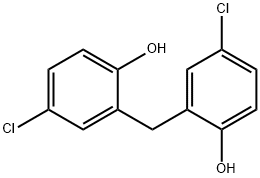
- Product Name:Dichlorophen
- CAS Number:97-23-4
- Molecular formula:C13H10Cl2O2
- Molecular Weight:269.12
Yield:-
Reaction Conditions:
at 80; for 3 h;
Steps:
Synthesis of 2, 20-methylene-bis-(4-chlorophenol)(dichlorophen) (1)
Equimolar quantities of p-chlorophenol and formaldehyde were taken in a round bottom flask and refluxed under water bath for 3 h. The resulting mixture was added to the distilled water. This mixture was heated to 80 °C and was decanted until the last trace of p-chlorophenol was removed. Crushed ice was added to the mixture and stirred vigorously until the product got precipitated. The product was recrystallised with toluene. Melting point (MP) was found to be 165 °C. FTIR (KBr, cm-1): C-H bending (aromatic) (1012, 668), O-H stretch (3502). 1H NMR (400 MHz, DMSO-d6): δ 3.81 (s, 2H, CH2), δ 5.0 (s, 2H,-OH), δ 6.55 (m, 2H, ArH), 6.91 (m, 4H, ArH). 13C NMR (100 MHz, DMSO-d6): δ 19.9 (-CH2), 117.6 (-CH), 126.9 (-C-Cl), 127.8, 131.6 (-C), 155.3 (-C-OH). GCMS (EI): [M]+ 268. Composition: C (58.02 %), H (3.75 %), Cl (26.35 %), O (11.89 %).
References:
Talluri, Sirishadevi;Kini, Suvarna G.;Kandale, Ajit;Kumar, Ganesh;Ohlyan, Renu [Medicinal Chemistry Research,2014,vol. 23,# 10,p. 4491 - 4499]

50-00-0
865 suppliers
$10.00/25g
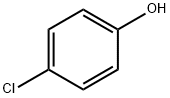
106-48-9
475 suppliers
$10.00/5 g
97-23-4
221 suppliers
$10.00/5g
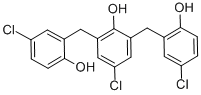
6642-07-5
2 suppliers
inquiry