| Identification | More | [Name]
Levulinic acid | [CAS]
123-76-2 | [Synonyms]
1-CARBOXY-3-BUTANONE
2-KETOVALERIC ACID
3-ACETYLPROPIONIC ACID
3-ACETYLPROPIONIC ACID BETA
4-KETOVALERIC ACID
4-OXO-N-VALERIC ACID
4-OXOPENTANOIC ACID
4-OXOVALERIANIC ACID
4-OXOVALERIC ACID
AKOS BBS-00003797
BETA-ACETYLPROPIONIC ACID
FEMA 2627
GAMMA-KETOVALERIC ACID
G-KETOVALERIC ACID
LA
Laevulinic acid
levulic acid
LEVULINIC ACID
PENTANOIC ACID, 4-OXO
2-Acetopropionicacid | [EINECS(EC#)]
204-649-2 | [Molecular Formula]
C5H8O3 | [MDL Number]
MFCD00002796 | [Molecular Weight]
116.12 | [MOL File]
123-76-2.mol |
| Chemical Properties | Back Directory | [Appearance]
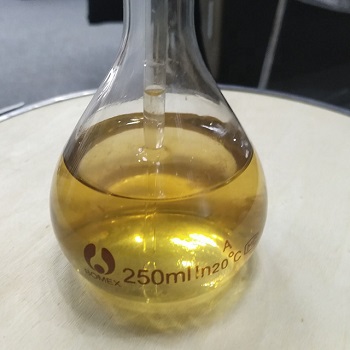
clear yellowish liquid after melting | [Melting point ]
30-33 °C (lit.) | [Boiling point ]
245-246 °C (lit.) | [density ]
1.134 g/mL at 25 °C(lit.)
| [vapor pressure ]
1 mm Hg ( 102 °C)
| [FEMA ]
2627 | [refractive index ]
n20/D 1.439(lit.)
| [Fp ]
280 °F
| [storage temp. ]
Store below +30°C. | [solubility ]
675g/l | [form ]
Liquid After Melting | [pka]
pKa 4.65(H2O,t = 25,c=0.03-0.001) (Uncertain) | [color ]
Clear yellow | [Odor]
at 100.00 %. sweet caramel acidic acetoin buttery | [biological source]
synthetic | [Odor Type]
caramellic | [Water Solubility ]
Soluble in water ( 675g/L at 20°C). | [Sensitive ]
Light Sensitive | [JECFA Number]
606 | [Merck ]
14,5472 | [BRN ]
506796 | [Major Application]
cleaning products
cosmetics
flavors and fragrances
food and beverages
personal care | [Cosmetics Ingredients Functions]
PERFUMING
SKIN CONDITIONING | [Cosmetic Ingredient Review (CIR)]
Levulinic acid (123-76-2) | [InChI]
1S/C5H8O3/c1-4(6)2-3-5(7)8/h2-3H2,1H3,(H,7,8) | [InChIKey]
JOOXCMJARBKPKM-UHFFFAOYSA-N | [SMILES]
CC(=O)CCC(O)=O | [LogP]
-0.498 | [Surface tension]
42.53mN/m at 298.15K | [CAS DataBase Reference]
123-76-2(CAS DataBase Reference) | [NIST Chemistry Reference]
Pentanoic acid, 4-oxo-(123-76-2) | [EPA Substance Registry System]
123-76-2(EPA Substance) |
| Safety Data | Back Directory | [Symbol(GHS) ]
 
GHS05,GHS07 | [Signal word ]
Danger | [Hazard statements ]
H302-H317-H318 | [Precautionary statements ]
P261-P264-P280-P301+P312-P302+P352-P305+P351+P338 | [Hazard Codes ]
Xn,C | [Risk Statements ]
R22:Harmful if swallowed.
R36/37/38:Irritating to eyes, respiratory system and skin .
R34:Causes burns. | [Safety Statements ]
S26:In case of contact with eyes, rinse immediately with plenty of water and seek medical advice .
S45:In case of accident or if you feel unwell, seek medical advice immediately (show label where possible) .
S36/37/39:Wear suitable protective clothing, gloves and eye/face protection . | [RIDADR ]
3261 | [WGK Germany ]
3
| [RTECS ]
OI1575000
| [TSCA ]
Yes | [REACH Registrations]
Active | [HazardClass ]
8 | [PackingGroup ]
III | [HS Code ]
29183000 | [Storage Class]
13 - Non Combustible Solids | [Hazard Classifications]
Acute Tox. 4 Oral
Eye Dam. 1
Skin Sens. 1 |
| Questions And Answer | Back Directory | [Chemical Properties]
White flake crystals, hygroscopic. clear yellowish liquid after melting.It is easily soluble in water and alcohol, ether organic solvents.
Levulinic acid conventionally is derived from refined petroleum but technological advances now permit the production of levulinic acid from biomass. Suitable feedstocks from the forest industry include pulp and paper mill residues, sawmill and logging residues, and solid municipal waste. It takes approximately 2 kg of cellulose to produce 1 kg of levulinic acid (US Department of Energy 1998). Obtaining enough raw materials to support the production of levulinic acid from biomass is not a foreseeable concern; Canada currently produces over 75 million tonnes of logging residues annually which, in turn, could produce 19 million tonnes of levulinic acid. | [Uses]
Levulinic acid is a biomass product and its derivatives, such as ethyl levulinate and alkyl levulinate, can be used as fuel additives.
levulinic acid is used for calcium levulinate in pharmaceuticals, as esters in solvents and plasticizers, and for making valerolactone. As its uses expand, it will probably be made from cellulosic wastes. Mesitonic acid, a homolog of levulinic acid is obtained by boiing mesityl oxide with KCN.
Hydrogenation of levulinic acid can produce other useful chemicals. Valeric-g-lactone, which is an effective solvent with extensive uses, can be obtained in very high yields. This compound may be hydrogenated to 1,4-pentandiol, which upon dehydration yields 1,3-pentadine (piperylene). Piperylene is known to polymerize to a rubbery mass and is therefore a source of synthetic rubber (Ghorpade and Hanna 1997).
Levulinic acid is a precursor for the synthesis of useful intermediates such as γ-valerolactone, ethyl levulinate, pentanoic acid and 2-methyl-tetrahydrofuran. Derivatization and esterification of levulinic acid results in potential biofuels.
It can also be used in:
The preparation of catalytic composite to synthesize 5-hydroxymethylfurfural and furfural.
The synthesis of a commercial fragrance, fraistone.
The synthesis of pyrrolidone derivatives via reductive amination.
The total synthesis of mycobacterial arabinogalactan.
| [Application]
It can be used as the raw materials of medicine, spices and paint, and used as solvent.
This product has wide applications. Levulinic acid can be used as both a carboxylic acid and can also be used as a ketone for reaction for making various kinds of products through esterification, halogenation, hydrogenation, oxidation dehydrogenation, condensation, etc., including resins, pharmaceuticals, spices, solvents, rubber and plastic additives, lubricants additives, surfactants and so on. In the pharmaceutical industry, its calcium salt (calcium fructose) can be used for intravenous injection. As a nutritional medicine, it helps to boost the formation of bone and maintain the normal excitability of nerves and muscles. It can also used for the production of indomethacin and plant hormones. Levulinic acid manufactured bisphenol acid can be made of water-soluble resin, used in the paper industry to produce filter paper. Levulinic acid is also an intermediate of pesticides and dyes.
Used for biochemical reagents, but also for organic synthesis
It can be used as an important chemical raw material or solvents. It can be used for the manufacturing of medicine (intravenous injection, indomethacin, etc.), resin (bisphenol acid water-soluble resin), spices (spices or tobacco spices), paint, paint, pesticides, and surfactants.
It can be used for biochemical research; manufacturing of esters and drugs. It is also the inhibitor of chlorophyll synthesis. | [Preparation]
The residue during the manufacturing of furfural with cotton seed shell or corncob sugar (furfural residue) or waste taro residue, through pressured hydrolysis with dilute acid, can be used to produce levulinic acid. The furfural residue was added to 10% dilute hydrochloric acid, the solidified solution was 1: 1.75, mixed and put into the hydrolysis pot, steamed at a pressure of 0.2MPa for 8-10 h. The diluted solution is then filtered and concentrated to a concentration of about 50%. It is further subject to vacuum distillation for collecting the fraction above 130 ℃ (2.67kPa) to obtain the finished product. Raw material consumption quota: potato tacar 7,000 kg/t, hydrochloric acid (fold 100%) 1800kg/t. Another method is manufacturing through the rearrangement and hydrolysis of sugar alcohol.
4% hydrochloric acid solution was added to the reaction pot, stir and heat to 97-100 ℃, slowly add the mixture of furfuryl alcohol, ethanol and water. After addition, stir 30 min. The filtrate was concentrated at 80 ° C (21.3 kPa) under reduced pressure to give crude levulinic acid. Then apply vacuum distillation, collect the fraction of 160-170 ° C (2.67kPa), and then re-distill once, to obtain the refined levulinic acid with the yield of about 75%. | [Content analysis]
Accurately weigh about 1.0 g of the sample, and put it into a 250ml Erlenmeyer flask containing 75~100ml water, add phenolphthalein test solution; apply 0.5 mol/L sodium hydroxide for titration to until it began to appear pink and maintain 15 s. Each mL of 0.5mol/L sodium hydroxide solution is equivalent to 58.08mg of the goods. | [Toxicity]
GRAS (FEMA). | [Usage limit]
FEMA (mg/kg): Beverage, cold drink, 14.0; Candy, baked goods, 53.0; Gelatin, pudding, 4.0.
FDA, §172.515 (2000): take proper amount as limit. |
| Hazard Information | Back Directory | [Description]
Levulinic acid has a tart, whiskey taste. It may be synthesized by
the action of more or less concentrated HCL on sucrose, glucose,
or fructose; hence, its reported presence in caramels. | [Physical properties]
Levulinic acid forms
colorless crystals that are readily soluble in water, ethanol, and diethyl ether. | [Occurrence]
Reported found in papaya, wheat bread, rice, sake and Chinese quince. | [Definition]
ChEBI: 4-oxopentanoic acid is an oxopentanoic acid with the oxo group in the 4-position. It has a role as a plant metabolite. It is a straight-chain saturated fatty acid and an oxopentanoic acid. It is a conjugate acid of a 4-oxopentanoate. | [Taste threshold values]
Taste characteristics at 70 ppm: acidic, sweet, creamy and slight dairy. | [Synthesis Reference(s)]
Tetrahedron Letters, 30, p. 5329, 1989 DOI: 10.1016/S0040-4039(01)93778-5 | [General Description]
Levulinic acid, an organic acid, is mainly used as a cigarette additive. | [storage]
Store at -20°C |
|
| Company Name: |
J & K SCIENTIFIC LTD.
|
| Telephone: |
18210857532 18210857532 |
| Website: |
https://www.jkchemical.com |
| Company Name: |
Alfa Aesar
|
| Telephone: |
400-6106006 |
| Website: |
http://chemicals.thermofisher.cn |
| Company Name: |
Energy Chemical
|
| Telephone: |
400-0056266 18918157536; |
| Website: |
http://www.energy-chemical.com |
|