| Identification | More | [Name]
Triadimenol | [CAS]
55219-65-3 | [Synonyms]
1-(4-CHLOROPHENOXY)-3,3-DIMETHYL-1-(1,2,4-TRIAZOL-1-YL)-BUTANOL
1-(4-CHLOROPHENOXY)-3,3-DIMETHYL-1-(1H-1,2,4-TRIAZOL-1-YL)BUTAN-2-OL
ACIZOL SUPER
alpha-tert-butyl-beta-(4-chlorophenoxy)-1H-1,2,4-triazole-1-ethanol
BAYFIDAN
BAYTAN
BAYTAN (TM)
PRODIMENOL
SAMET
SUMMIT
TRIADIM
TRIADIMENOL
TRIADIMENOL ISOMER A
(1rs,2rs,1rs,2sr)-1-(4-chlorophenoxy)-3,3-dimethyl-1-(1h-1,2,4-triazol-1-yl)
1-(4-Chlorophenoxy)-3,3-dimethyl-1-(1H-1,2,4-triazol-1-yl)-2-butanol
1H-1,2,4-Triazole-1-ethanol, beta-(4-chlorophenoxy)-alpha-(1,1-dimethylethyl)-
2-(4-chlorophenoxy)-1-tert-butyl-2-(1h-1,2,4-triazole-1-yl)-ethano
2-(4-Chlorophenoxy)-1-tert-butyl-2-(1H-1,2,4-triazole-1-yl)ethanol
a-(4-chlorophenoxy)-b-(1,1-dimethylethyl)-1H-1,2,4-triazole-1-ethanol
BAY KWG 0519 | [EINECS(EC#)]
259-537-6 | [Molecular Formula]
C14H18ClN3O2 | [MDL Number]
MFCD00055507 | [Molecular Weight]
295.76 | [MOL File]
55219-65-3.mol |
| Chemical Properties | Back Directory | [Melting point ]
112-117° | [Boiling point ]
465.4±55.0 °C(Predicted) | [density ]
1.2990 (rough estimate) | [vapor pressure ]
A 6 x l0-7 Pa (20 °C); B 4 x l0-7 Pa (20 °C) | [refractive index ]
1.5270 (estimate) | [Fp ]
2 °C | [storage temp. ]
2-8°C | [solubility ]
DMSO (Slightly), Methanol (Slightly) | [form ]
neat | [pka]
13.29±0.20(Predicted) | [Water Solubility ]
A 62 mg l-1 (20 °C); B 33 mg l-1(20 °C) | [color ]
White to Off-White | [Merck ]
13,9667 | [BRN ]
616470 | [Henry's Law Constant]
7.6×10⁶ mol/(m3Pa) at 25℃, HSDB (2015) | [InChI]
1S/C14H18ClN3O2/c1-14(2,3)12(19)13(18-9-16-8-17-18)20-11-6-4-10(15)5-7-11/h4-9,12-13,19H,1-3H3 | [InChIKey]
BAZVSMNPJJMILC-UHFFFAOYSA-N | [SMILES]
CC(C)(C)C(O)C(Oc1ccc(Cl)cc1)n2cncn2 | [LogP]
2.900 | [CAS DataBase Reference]
55219-65-3(CAS DataBase Reference) | [NIST Chemistry Reference]
Triadimenol(55219-65-3) | [EPA Substance Registry System]
55219-65-3(EPA Substance) |
| Safety Data | Back Directory | [Symbol(GHS) ]
  
GHS07,GHS08,GHS09 | [Signal word ]
Danger | [Hazard statements ]
H302-H360D-H362-H411 | [Precautionary statements ]
P202-P260-P263-P273-P301+P312-P308+P313 | [Hazard Codes ]
Xn,F,T | [Risk Statements ]
R22:Harmful if swallowed.
R52/53:Harmful to aquatic organisms, may cause long-term adverse effects in the aquatic environment .
R36:Irritating to the eyes.
R20/21/22:Harmful by inhalation, in contact with skin and if swallowed .
R11:Highly Flammable.
R23:Toxic by inhalation. | [Safety Statements ]
S22:Do not breathe dust .
S61:Avoid release to the environment. Refer to special instructions safety data sheet .
S36:Wear suitable protective clothing .
S26:In case of contact with eyes, rinse immediately with plenty of water and seek medical advice .
S45:In case of accident or if you feel unwell, seek medical advice immediately (show label where possible) . | [RIDADR ]
2588 | [WGK Germany ]
2 | [RTECS ]
KK2200000 | [REACH Registrations]
Active | [HazardClass ]
6.1(b) | [PackingGroup ]
III | [HS Code ]
29339900 | [Storage Class]
6.1C - Combustible acute toxic Cat.3
toxic compounds or compounds which causing chronic effects | [Hazard Classifications]
Acute Tox. 4 Oral
Aquatic Chronic 2
Lact.
Repr. 1B | [Hazardous Substances Data]
55219-65-3(Hazardous Substances Data) |
| Questions And Answer | Back Directory | [Chemical properties]
The pure triadimenol is white, tasteless fine crystalline powder. m.p.: 112 ° C, vapor pressure: 1 × 10 -3 Pa (20 ° C). Solubility in organic solvents: cyclohexane 40%, isopropanol 15%, methylene chloride 10%, toluene 4%; Solubility in water: 0.12g / L. Stable in neutral or weak acid medium, easy to break down when boiled in strong acidic medium.
| [Uses]
It is a systemic broad-spectrum seed treatment fungicide which can kill pathogens attached to the internal and external surface of seed. It works through the inhibition of fungal ergosterol biosynthesis. It’s used on cereal grains to control powdery mildew and smut diseases such as loose smut, stinking smut and root rot on wheat, loose smut, rust, leaf stripe disease and net blotch etc on barley, and it is more than 90% effective when 100kg of seeds are treated with 30 ~ 50g of 25% DS. It is more than 90% effective when 100kg of seeds are treated with 42 ~ 75g of 25% DS to control smut on corn and sorghum head smut. If 100kg of seeds are treated with 30g of triadimenol and 5g of furidazol, it will be 92% to 100% effective for the control of loose smut, stripe disease, net blotch and root rot on spring barley , loose smut, stinking smut, snow mold on winter wheat, and leaf stripe disease, loose smut on spring oat.
Triadimenol is a broad-spectrum fungicide with high efficiency and low toxicity. It is used on wheat and rice to control rust, powdery mildew, sheath blight and other diseases, and has a significant yield increasing effect. It can be also used as a cereal seed treatment and for the control of cereal smut.
| [Toxicity]
The acute oral toxicity LD50 in rats was 1161 mg / kg (female), 1105 mg / kg (male). The acute oral toxicity LD50 in mice was 1300 mg / kg (male & female). No effect dose for dogs and rats during 90 days feeding test: 600mg / kg • d. The acute inhalation The LC50 in goldfish and rainbow trout was 10~15mg/L and 23.5mg/L respectively (both 96 hours). The LD50 in quail was > 1000mg / kg. No effect on bees.
| [Preparation method]
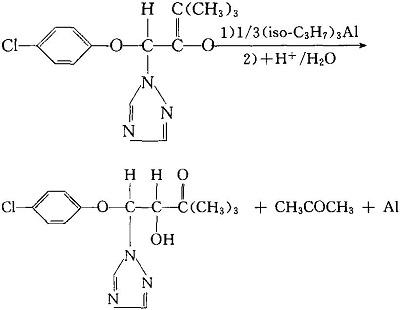
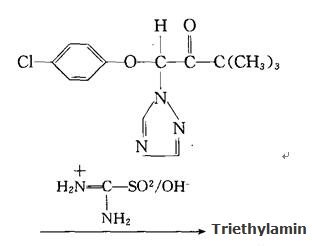
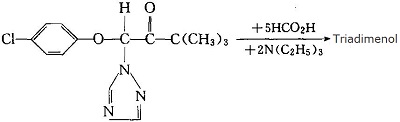
Mostly, using triadimefon as the starting material , triadimenol is prepared through different reduction processes.
1. Reduction by hydrogen in the presence of a catalyst and any polar solvent, or reduction by aluminum isopropoxide in the presence of a solvent:
2. Reduction by borohydride in the presence of any polar solvent.
3. Reduction by formamidine sulfinic acid and alkali metal hydroxide in the presence of any polar solvent:
4. Reduction by using formic acid - triethylamine adduct as a reducing agent:
 |
| Hazard Information | Back Directory | [Description]
Triadimenol is a metabolite of triadimefon (Item No. 18714), a broad-spectrum chiral triazole fungicide, that is formed by reduction of a carbonyl group to the corresponding alcohol.1 It is teratogenic, inducing cranial nerve and ganglia abnormalities in a rat post-implantation whole embryo culture model when used at concentrations ranging from 12.5 to 125 μM.2 In vivo, triadimenol induces embryotoxicity in rats and rabbits when administered orally at doses of 100 and 40 mg/kg, respectively. Embryonic exposure to triadimenol (3-3,000 μg/L) induces embryonic mortality as well as decreases fertility and increases the number of female offspring in medaka fish (O. latipes).3 | [Definition]
ChEBI: A member of the class of triazoles that is 3,3-dimethyl-1-(1,2,4-triazol-1-yl)butane-1,2-diol substituted at position O1 by a 4-chlorophenyl group. A fungicide for cereals, beet and brassicas used to control a range of diseases including powdery mildew, ru
ts, bunts and smuts. | [Production Methods]
Triadimenol is commercially produced through a multi-step chemical synthesis involving triazole chemistry. It typically begins with the synthesis of a chlorinated benzyl alcohol derivative, which is then reacted with 1,2,4-triazole to form the core triazole ring structure. This intermediate undergoes further alkylation and oxidation steps to introduce the hydroxyl group and complete the formation of the active fungicidal molecule. The process requires precise control of reaction conditions, such as temperature, solvent choice, and pH, to ensure high yield and purity. | [Agricultural Uses]
Fungicide: Triadimenol is used to control seed-and soil-borne
diseases and to provide early season control of foliar
diseases. It is applied to seeds of barley, corn, oats, rye,
sorghum and wheat and also to fruits, vegetables and ornamentals. Registered for use in EU countries
. Registered
for use in the U.S.
U.S. Maximum Allowable Residue Levels for Triadimenol | [Trade name]
BAYFIDAN®; BAYFRDAN EW®;
BAY KWG 0519®; BAYTAN® SEED TREATMENT;
BAYTAN 30® FUNGICIDE; PROTEGE ALLEGIANCE
BAYTAN®; SPINNAKER®; SUMMIT®;
TRIADIMENOL®; TRIAFOL®; TRIAPHOL® | [Mechanism of action]
Selective with curative, protective and eradicant action. Disrupts membrane function. Sterol biosynthesis inhibitor. | [Metabolic pathway]
When triadimenol is irradiated by UV light in methanol
solution, two major degradation products are identified
as 1-(4-chlorophenoxy)-3,3-dimethylbutan-2-one and
1-phenoxy-3,3-dimethyl-1-(1H-1,2,4-triazol-1-yl)butan-
2-ol. When a spray deposit on apple leaves is
exposed outdoors to natural sunlight, the only product
detected is the butanone metabolite. The butanone
metabolite has very low fungicidal activity against
apple powdery mildew, whereas the butanol metabolite
gives some control of infection. | [storage]
Store at -20°C | [Degradation]
When a methanolic solution of triadimenol (1) in borosilicate glass
apparatus was irradiated by a medium pressure mercury lamp for 20
days, 50% of the triadimenol was photodegraded. The products identified
were 1-(4-chlorophenoxy)-3,3-dimethyl-1-(1H -1,2,4-triazol-1-yl)butan-2-
one (major product) (2), 4-chlorophenol (3) and 1-phenoxy-3,3-dimethyl-
1-(1H-1,2,4-triazol-1-yl)butan-2-ol(4 ). When triadimenol was irradiated
as a solid deposit, 55% of the parent compound was recovered after 18
days and the same products were identified. Losses may be accounted
for by volatilisation or photodegradation (Clark and Watkins, 1986)
(Scheme 1). The only major product detected 33 days after triadimenol
had been applied to apple tree leaf surfaces exposed to light outdoors
was 2. | [References]
[1] QIUXUAN SHEN. Enantioselective metabolism of triadimefon and its chiral metabolite triadimenol in lizards[J]. Ecotoxicology and Environmental Safety, 2017, 143: Pages 159-165. DOI: 10.1016/j.ecoenv.2017.05.024
[2] E MENEGOLA. In vitro teratogenic potential of two antifungal triazoles: triadimefon and triadimenol.[J]. In Vitro Cellular & Developmental Biology. Animal, 2000, 36 2: 88-95. DOI: 10.1290/1071-2690(2000)036<0088:ivtpot>2.0.co;2
[3] SZU-HUNG CHU Pei J C Pei Han Liao. Developmental exposures to an azole fungicide triadimenol at environmentally relevant concentrations cause reproductive dysfunction in females of medaka fish[J]. Chemosphere, 2016, 152: Pages 181-189. DOI: 10.1016/j.chemosphere.2016.02.078 | [Pesticide Type]
Fungicide; Metabolite |
|
| Company Name: |
J & K SCIENTIFIC LTD.
|
| Telephone: |
18210857532 18210857532 |
| Website: |
https://www.jkchemical.com |
|