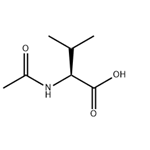
- N-Acetyl-L-valine
-
-
2025-04-04
- CAS:96-81-1
- Min. Order: 1kg
- Purity: 98%
- Supply Ability: 1Ton
|
| | N-Acetyl-L-valine Basic information |
| Product Name: | N-Acetyl-L-valine | | Synonyms: | N-alpha-Actetyl-L-valine;(S)-2-ACETAMIDO-3-METHYLBUTANOIC ACID;N-ACETYL-L-VALINE extrapure for biochemistry;(2S)-2-acetamido-3-methylbutanoic acid;(2S)-2-acetamido-3-methyl-butanoic acid;(2S)-2-acetamido-3-methyl-butyric acid;L-Valine, N-acetyl-Valine, N-acetyl-, L-Ac-L-Val-OH;N-α-Actetyl-L-valine | | CAS: | 96-81-1 | | MF: | C7H13NO3 | | MW: | 159.18 | | EINECS: | 202-537-8 | | Product Categories: | amino;amino acid;Amino Acid Derivatives;Amino Acids | | Mol File: | 96-81-1.mol | 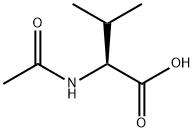 |
| | N-Acetyl-L-valine Chemical Properties |
| Melting point | 163-167℃ | | alpha | [α]D20 -16~-20゜ (c=5, C2H5OH) | | Boiling point | 362.2±25.0 °C(Predicted) | | density | 1.094±0.06 g/cm3(Predicted) | | storage temp. | Sealed in dry,Store in freezer, under -20°C | | solubility | soluble in Methanol | | form | Crystalline Powder | | pka | 3.62±0.10(Predicted) | | color | White | | Optical Rotation | -18° (C=0.01 g/ml, H2O) | | Major Application | peptide synthesis | | InChI | InChI=1S/C7H13NO3/c1-4(2)6(7(10)11)8-5(3)9/h4,6H,1-3H3,(H,8,9)(H,10,11)/t6-/m0/s1 | | InChIKey | IHYJTAOFMMMOPX-LURJTMIESA-N | | SMILES | C(O)(=O)[C@H](C(C)C)NC(C)=O | | CAS DataBase Reference | 96-81-1(CAS DataBase Reference) | | NIST Chemistry Reference | L-valine, n-acetyl-(96-81-1) |
| Hazard Codes | Xi | | Risk Statements | 36-43 | | Safety Statements | 26-36/37 | | WGK Germany | 3 | | HS Code | 2922498590 | | Storage Class | 11 - Combustible Solids |
| | N-Acetyl-L-valine Usage And Synthesis |
| Chemical Properties | White crystalline powder | | Uses | Ac-Val-OH may be employed as a ligand for the meta-selective tert-alkylation reaction. | | Definition | ChEBI: An L-valine derivative in which one of the amino hydrogens of L-valine has been replaced by an acetyl group. | | General Description | Ac-Val-OH is an N-protected valine amino acid ligand. It participates in the 2,6-diolefination reaction of phenylacetic acids. | | Synthesis | The general procedure for the synthesis of N-acetyl-L-valine from L-valine and acetic anhydride was as follows: L-valine (200 g, 1.7 mol) was dissolved in distilled water (500 mL), followed by the addition of 30% sodium hydroxide solution (170 mL). After cooling the reaction mixture to 0-5°C, acetic anhydride (32 mL, 1.4 eq.) was added slowly and dropwise. This was repeated six times (total acetic anhydride: 6 x 32 mL; 30% sodium hydroxide solution: 6 x 34 mL) by alternating dropwise additions of 30% sodium hydroxide solution (34 mL) and acetic anhydride (32 mL) while maintaining the temperature at 0-5°C. After the addition was completed, the reaction mixture continued to be stirred at 0°C for 2 hours. Subsequently, 32% hydrochloric acid (380 mL) was slowly added to adjust the pH to below 3 while maintaining the reaction temperature at 0°C. The resulting slurry was allowed to crystallize for 12 h. The solid product was collected by filtration and the filter cake was washed with 0.1 N hydrochloric acid (100 mL). Finally, the wet N-acetyl-L-valine was dried to give 233 g of white crystalline solid in 86% yield. | | IC 50 | Human Endogenous Metabolite | | References | [1] New Journal of Chemistry, 2002, vol. 26, # 7, p. 834 - 843
[2] Synthetic Communications, 1992, vol. 22, # 2, p. 257 - 264
[3] Patent: WO2005/40097, 2005, A1. Location in patent: Page/Page column 9
[4] Journal of the American Chemical Society, 2011, vol. 133, # 43, p. 17176 - 17179
[5] Journal of the American Chemical Society, 1956, vol. 78, p. 4636,4642 |
| | N-Acetyl-L-valine Preparation Products And Raw materials |
|