


HEPES
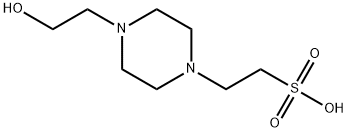
- CAS No.
- 7365-45-9
- Chemical Name:
- HEPES
- Synonyms
- HEPES BUFFER;4-(2-HYDROXYETHYL)-1-PIPERAZINEETHANESULFONIC ACID;HYDROXYETHYLPIPERAZINE ETHANE SULFONIC ACID;4-(2-HYDROXYETHYL)PIPERAZINE-1-ETHANESULFONIC ACID;hepes solution;Biological Buffer;HEPES buffer Solution;EPES;4-(2-hydroxyethyl)piperazin-1-ylethanesulphonic acid;2-[4-(2-HYDROXYETHYL)-1-PIPERAZINYL]ETHANESULFONIC ACID
- CBNumber:
- CB5408557
- Molecular Formula:
- C8H18N2O4S
- Molecular Weight:
- 238.3
- MDL Number:
- MFCD00006158
- MOL File:
- 7365-45-9.mol
- MSDS File:
- SDS
- TDS File:
- TDS
| Melting point | 234-238 °C |
|---|---|
| Boiling point | 408℃[at 101 325 Pa] |
| bulk density | 560kg/m3 |
| Density | 1.07 g/mL at 20 °C |
| vapor pressure | 0Pa at 25℃ |
| refractive index |
n |
| storage temp. | 2-8°C |
| solubility | H2O: 1 M at 20 °C, clear, colorless |
| form | powder |
| color | White |
| PH | 5.0-6.5 (1Maqueous solution) |
| pka | 7.5(at 25℃) |
| PH Range | 7.0 - 7.6 |
| biological source | synthetic |
| Water Solubility | Soluble |
| λmax |
λ: 260 nm Amax: 0.06 λ: 280 nm Amax: 0.04 |
| Merck | 14,4654 |
| BRN | 883043 |
| Stability | Stable. Combustible. Incompatible with strong oxidizing agents. Protect from moisture. |
| Major Application | diagnostic assay manufacturing |
| Cosmetics Ingredients Functions | BUFFERING |
| InChI | 1S/C8H18N2O4S/c11-7-5-9-1-3-10(4-2-9)6-8-15(12,13)14/h11H,1-8H2,(H,12,13,14) |
| InChIKey | JKMHFZQWWAIEOD-UHFFFAOYSA-N |
| SMILES | OCCN1CCN(CC1)CCS(O)(=O)=O |
| LogP | -3.85 at 20℃ |
| CAS DataBase Reference | 7365-45-9(CAS DataBase Reference) |
| EWG's Food Scores | 1 |
| FDA UNII | RWW266YE9I |
| EPA Substance Registry System | 1-Piperazineethanesulfonic acid, 4-(2-hydroxyethyl)- (7365-45-9) |
| Absorption | ≤0.05 at 290 in H2O at 33% |
| UNSPSC Code | 41116107 |
| NACRES | NA.75 |
SAFETY
Risk and Safety Statements
| Symbol(GHS) |  GHS07 |
|||||||||
|---|---|---|---|---|---|---|---|---|---|---|
| Signal word | Warning | |||||||||
| Hazard statements | H302-H315-H319-H335 | |||||||||
| Precautionary statements | P261-P271-P280 | |||||||||
| PPE | Eyeshields, Gloves, type N95 (US) | |||||||||
| Hazard Codes | Xi | |||||||||
| Risk Statements | 36/37/38 | |||||||||
| Safety Statements | 24/25-22-36-26 | |||||||||
| WGK Germany | 1 | |||||||||
| RTECS | TL6809000 | |||||||||
| TSCA | TSCA listed | |||||||||
| HS Code | 29335995 | |||||||||
| Storage Class | 13 - Non Combustible Solids | |||||||||
| REACH Registrations | Active | |||||||||
| NFPA 704 |
|
HEPES price More Price(216)
| Manufacturer | Product number | Product description | CAS number | Packaging | Price | Updated | Buy |
|---|---|---|---|---|---|---|---|
| Sigma-Aldrich | H4034 | HEPES BioPerformance Certified, ≥99.5% (titration), suitable for cell culture | 7365-45-9 | 25KG | $6780 | 2026-04-30 | Buy |
| Sigma-Aldrich | H3375 | HEPES ≥99.5% (titration) | 7365-45-9 | 25KG | $6460 | 2026-04-30 | Buy |
| Sigma-Aldrich | H3375 | HEPES ≥99.5% (titration) | 7365-45-9 | 50KG | $12200 | 2026-04-30 | Buy |
| Sigma-Aldrich | H23830 | HEPES reagent grade, ≥99% (titration), crystalline | 7365-45-9 | 100 g | $72.6 | 2026-04-30 | Buy |
| Sigma-Aldrich | H23830 | HEPES reagent grade, ≥99% (titration), crystalline | 7365-45-9 | 500 g | $297 | 2026-04-30 | Buy |
HEPES Chemical Properties, Uses, Production
Description
HEPES has been described as one of the best all-purpose buffers available for biological research. At biological pH, the molecule is zwitterionic, and is effective as a buffer at pH 6.8 to 8.2 (pKa 7.55). It is typically used in cell culture at concentration between 5mM to 30 mM. HEPES has been used in a wide variety of applications, including tissue culture. It is commonly used to buffer cell culture media in air. HEPES finds its usage in in vitro experiments on Mg.
Chemical Properties
White crystalline powder
Uses
Non-toxic to cell. It is used as a hydrogen ion buffer, which can control the constant pH range for long term. The concentration is 10-50mmol/L. Generally, 20mmol/LHEPES in nutrient solution can get buffer ability.
Uses
HEPES is common buffer for biological sciences, particularly used in cell culture to maintain physiological pH. It acts a buffering component, which is used in the preparation of buffers. It is described as one of the best all-purpose buffers available for use in biological research.
HEPES has been used as a component of:
Hank′s balanced salt solution, Dulbecco′s modified eagle′s medium and no-glucose DMEM, which are used for the preparation of tissue slices.
Buffers used in localized conductance measurements on the basolateral side of culture inserts to examine cation selectivity.
Uses
HEPES is a biological buffer. It may be used in isoelectric focusing applications and as a buffer in the quantitative and selective measurement of antigen-antibody reactions. HEPES is reportedly superior to NaHCO3 in controlling pH in tissue and organ culture. HEPES is not recommended for use with the Folin-Ciocalteu protein assay.
Definition
ChEBI: A HEPES that is ethanesulfonate substituted by a 4-(2-hydroxyethyl)piperazin-4-ium-1-yl group at position 2.
General Description
HEPES buffered saline is a tissue culture buffer, which is used to maintain the pH of cell culture. It is water soluble and atmosphere independent. HEPES destroys magnesium in sodium chloride solutions.
Biological Activity
Multi purpose buffer used in biological research.
Biological Activity
HEPES is a multi purpose HEPES buffer used in cell culture and other biological research. Working pH range in aqueous solution: 6.8 - 8.2. Does not form complexes with metal ions. Used in cell culture media.
Biotechnological Applications
HEPES serves as a buffering agent and transfection reagent that mediates cytoplasmic delivery of proteins into cells, and mixing it with proteins such as antibodies, recombinant proteins, and small peptides yields protein–HEPES mixtures suitable for transfection into cultured cells[1]. As a zwitterionic buffering agent in cell culture media, HEPES activates MiT/TFE-dependent lysosomal-autophagic gene networks and induces lysosome biogenesis, while its addition to culture media also triggers a lysosomal stress-related inflammatory phenotype and affects host-immune gene programs in RAW macrophages[2]. HEPES serves as a building block for molecular engineering of biomedical polymers, functioning as a pendant group in the zwitterionic polymer polyHEPES-pz intended for biomedical applications[3].
Synthesis
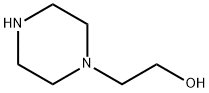
103-76-4
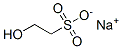
1562-00-1

7365-45-9
The general procedure for the synthesis of 4-hydroxyethylpiperazineethanesulfonic acid from N-hydroxyethylpiperazine and sodium 2-hydroxyethylsulfonate is as follows: 0.5 mole of N-hydroxyethylpiperazine, 0.565 mole of sodium 2-hydroxyethylsulfonate, and 500 ml of methanol were added to a 1000 ml four-necked flask fitted with a refluxing condenser tube, and the condensation reaction was carried out under sufficient stirring. The reaction was first carried out at 50 °C for 2.5 minutes, then gradually heated to reflux and continued for 3.0 hours. The reaction was cooled after completion of the reaction to give a reaction mixture containing 4-hydroxyethylpiperazine ethanesulfonate. The yield of 4-hydroxyethylpiperazine ethanesulfonate was 93.6% as analyzed by high performance liquid chromatography. A 20 liter solution of 4-hydroxyethylpiperazine ethanesulfonate at a mass concentration of 15 wt% was diluted to 5 wt% with deionized water under stirring, followed by removal of sodium chloride by dialysis. Then the purified HEPES product was obtained by evaporation concentration, cooling crystallization and filtration. Finally, the product was washed once with anhydrous methanol and dried under vacuum to obtain purified HEPES.A sample of purified HEPES was dissolved and tested for purity, which showed a purity of 99.9%, a yield of 85.6%, a pH of 6.46, and a concentration of chloride ions of 6.8 μg/g.
storage
Room temperature
Purification Methods
Crystallise the acid from hot EtOH and water. It is a useful buffer. [Beilstein 23 V 376.]
References
[1] Chen, S.-H., Chao, A., Tsai, C.-L., Sue, S.-C., Lin, C.-Y., Lee, Y.-Z., Hung, Y.-L., Chao, A.-S., Cheng, A.-J., Wang, H.-S., & Wang, T.-H. (2018). Utilization of HEPES for Enhancing Protein Transfection into Mammalian Cells. Molecular Therapy-Methods & Clinical Development, 13, 99–111. https://doi.org/10.1016/j.omtm.2018.12.005
[2] Tol, M. J., van der Lienden, M. J. C., Gabriel, T. L., Hagen, J. J., Scheij, S., Veenendaal, T., Klumperman, J., Donker-Koopman, W. E., Verhoeven, A. J., Overkleeft, H., Aerts, J. M., Argmann, C. A., & van Eijk, M. (2018). HEPES activates a MiT/TFE-dependent lysosomal-autophagic gene network in cultured cells: A call for caution. Autophagy, 14 3, 437–449. https://doi.org/10.1080/15548627.2017.1419118
[3] Tagad, H. D., Marin, A., Hlushko, R., & Andrianov, A. K. (2024). Hydrolytically Degradable Zwitterionic Polyphosphazene Containing HEPES Moieties as Side Groups. Biomacromolecules, 6791–6800. https://doi.org/10.1021/acs.biomac.4c01008
References
[1] Patent: CN106905262, 2017, A. Location in patent: Paragraph 0034; 0035; 0047
HEPES Preparation Products And Raw materials
| Supplier | Tel | Country | ProdList | Advantage | |
|---|---|---|---|---|---|
| Hubei xinghengkang Chemical Technology Co., Ltd | 027-88878869 18162384755 | 969094702@qq.com | China | 55 | 58 |
| Hubei New Desheng Materials Technology Co., Ltd. | 0711-3702650 18971041571 | vickyzhao@whdschem.com | China | 57 | 58 |
| Shanghai Jizhi Biochemical Technology Co. Ltd. | 021-4009004166/18616739031 18616739031 | 3007523370@qq.com | China | 40000 | 58 |
| Nanjing Search Biotech Co., Ltd | +86-025-81682922 +86-13515111588 | sales@searchbio.com.cn | China | 137 | 68 |
| AILY INTL CHEMICAL CORP LTD | 025-83208295 18913388297 | ben@ailychem.com | China | 132 | 50 |
| Jiangsu Boquan Biotechnology Co., Ltd. | 19351501195 | 1464906612@qq.com | China | 494 | 58 |
| Hangzhou Bingochem Co., Ltd. | 0571-87658025 | sales@bingochem.com | China | 21532 | 58 |
| Hunan Hengfei bio-pharmaceutical Co. , Ltd. | 0746-6222194 13874779848 | 57182844@qq.com | China | 58 | 58 |
| ZHENYOU LIAO (WUHAN) BIOTECHNOLOGY CO., LTD. | 18062454418 | info@zenunite-bio.com | China | 75 | 58 |
| J & K SCIENTIFIC LTD. | 18210857532 18210857532 | jkinfo@jkchemical.com | China | 96815 | 76 |
Related articles
- HEPES: Chemical Properties and Applications in Cell Culture
- HEPES, a zwitterionic buffer, maintains pH stability, influences cellular functions, and inhibits prion protein conversion, ma....
- Oct 30,2024
- Uses and characteristics of HEPES buffer
- HEPES (4-(2-hydroxyethyl)-1-piperazineethanesulfonic acid) is a zwitterionic sulfonic acid buffering agent; one of the twenty ....
- Apr 13,2022
- What is 4-(2-Hydroxyethyl)piperazine-1-ethane-sulfonic acid( HEPES)?
- 4-(2-Hydroxyethyl)piperazine-1-ethane-sulfonic acid (HEPES) has been described as one of the best all-purpose buffers availabl....
- Jan 6,2020
Related Questions
Ask a questionView Latest Price from HEPES manufacturers
| Image | Update time | Product | Price | Min. Order | Purity | Supply Ability | Manufacturer | |
|---|---|---|---|---|---|---|---|---|
 |
2026-10-08 | 4-(2-Hydroxyethyl)-1-piperazineethanesulfonic acid
7365-45-9
|
1KG | 99% | 200mt | Jinan Finer Chemical Co., Ltd | ||
 |
2026-10-08 | HEPES
7365-45-9
|
$52.00 | 500g | >=99.5% (titration) | 100kg | Shanghai Acmec Biochemical Technology Co., Ltd. | |
 |
2026-10-08 | HEPES
7365-45-9
|
$52.00 | 500g | >=99.5% (titration) | 100kg | Shanghai Acmec Biochemical Technology Co., Ltd. |
-
- 4-(2-Hydroxyethyl)-1-piperazineethanesulfonic acid
7365-45-9
- $0.00
- 99%
- Jinan Finer Chemical Co., Ltd
-
- HEPES
7365-45-9
- $52.00
- >=99.5% (titration)
- Shanghai Acmec Biochemical Technology Co., Ltd.
-
- HEPES
7365-45-9
- $52.00
- >=99.5% (titration)
- Shanghai Acmec Biochemical Technology Co., Ltd.
